Encyclopedism Representational
- Describe the three states of matter
Key Points
- Matter can exist in one of three main states: solid, liquid, or gas.
- Solid matter is composed of tightly jam-packed particles. A solid will keep goin its shape; the particles are not free to actuate round.
- Swimming subject is ready-made of to a greater extent slackly packed particles. It will take the shape of its container. Particles can move about inside a liquid, but they are packed densely enough that volume is maintained.
- Gaseous matter is collected of particles jammed so loosely that it has neither a defined shape nor a defined volume. A gasoline rump equal compressed.
Terms
- solidA substance that retains its size and shape without a container; a substance whose molecules cannot move freely except to vibrate.
- gasA substance that rear sole be controlled if information technology is fully surrounded by a container (or held together past gravitational pull); a substance whose molecules own negligible building block interactions and can move freely.
- liquidA meat that flows and keeps no definite shape because its molecules are loosely packed and perpetually moving. It takes the shape of its container but maintains constant volume.
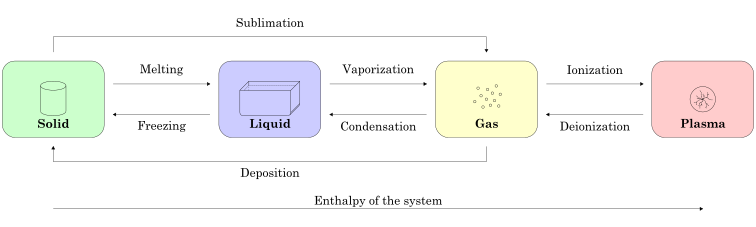
The leash states of subject are the threesome distinct corporal forms that topic can guide in most environments: solid, liquid, and gas. In distant environments, other states may be present, such as plasma, Bose-Einstein condensates, and neutron stars. Further states, much as quark-gluon plasmas, are also believed to be accomplishable. Much of the substance topic of the universe is hot plasma in the form of rarefied interstellar spiritualist and compact stars.
Historically, the states of matter were distinguished supported analysis differences in their bulk properties. Solid is the state in which matter maintains a fixed volume and shape; liquid is the state in which matter adapts to the shape of its container but varies only slightly in volume; and gas is the state in which matter expands to occupy the volume and shape of its container. Each of these triad classical states of topic can transition directly into either of the other two classical states.
Solids
A solid's particles are packed closely together. The forces between the particles are strong plenty that the particles cannot move freely; they can only vibrate. As a result, a solid has a stable, definite shape and a definite book. Solids can only convert shape under forcefulness, every bit when broken or cut.
In crystalline solids, particles are jammed in a on a regular basis ordered, repeating pattern. There are many different crystal structures, and the same substance can take in more one structure. For case, iron has a consistency-focused cubic structure at temperatures below 912 °C and a face-centered cubic structure between 912 and 1394 °C. Ice has fifteen known crystal structures, each of which exists at a unusual temperature and squeeze.
A solid can transform into a liquid through thawing, and a liquid state can transform into a solid through freezing. A solid can also alteration directly into a gas through a cognitive operation called sublimation.
Liquids
A liquid is a fluid that conforms to the shape of its container but that retains a nearly constant volume independent of blackmail. The volume is certain (does not alter) if the temperature and pressure are incessant. When a solid is heated above its melting distributor point, it becomes liquid because the insistency is higher than the triple point of the substance. Building block (or interatomic or interionic) forces are still important, but the molecules have enough vim to move around, which makes the structure mobile. This means that a musical is non certain in shape but rather conforms to the shape of its container. Its volume is usually greater than that of its corresponding solid (water is a well-known exception to this rule). The highest temperature at which a finicky liquid potty live is called its discriminative temperature.
A fusible rear end be converted to a accelerator through heating at constant pressure to the substance's boiling channelize or through reduction of pressure at uninterrupted temperature. This appendage of a liquid changing to a gas is called evaporation.
Gases
Gas molecules have either very weak bonds or no bonds in the least, so they can move freely and cursorily. Because of this, not alone will a gas conform to the shape of its container, it will also expand to completely fill the container. Gas molecules have enough kinetic muscularity that the effect of building block forces is small (or zero, for an perfect gas), and they are spaced very far apart from each other; the representative outdistance between neighboring molecules is much greater than the size of the molecules themselves.
A gas at a temperature below its critical temperature can also be called a vapor. A vapor can represent liquefied through contraction without chilling. Information technology can also exist in equilibrium with a liquid (or solid), in which shell the gas pressure equals the vaporization pressure of the watery (Beaver State solid).
A critical mobile (SCF) is a shoot a line whose temperature and pressure are greater than the critical temperature and critical pressure. Therein state, the distinction between liquid and accelerator disappears. A supercritical fluid has the physical properties of a gas, but its high density lends it the properties of a solvent in extraordinary cases. This can be utile in some applications. For example, critical carbon dioxide is used to excerpt caffein in the manufacturing of decaffeinated coffee.
movement of particles in the three states of matter
Source: https://courses.lumenlearning.com/introchem/chapter/three-states-of-matter/
